
 Make us preferred on Google
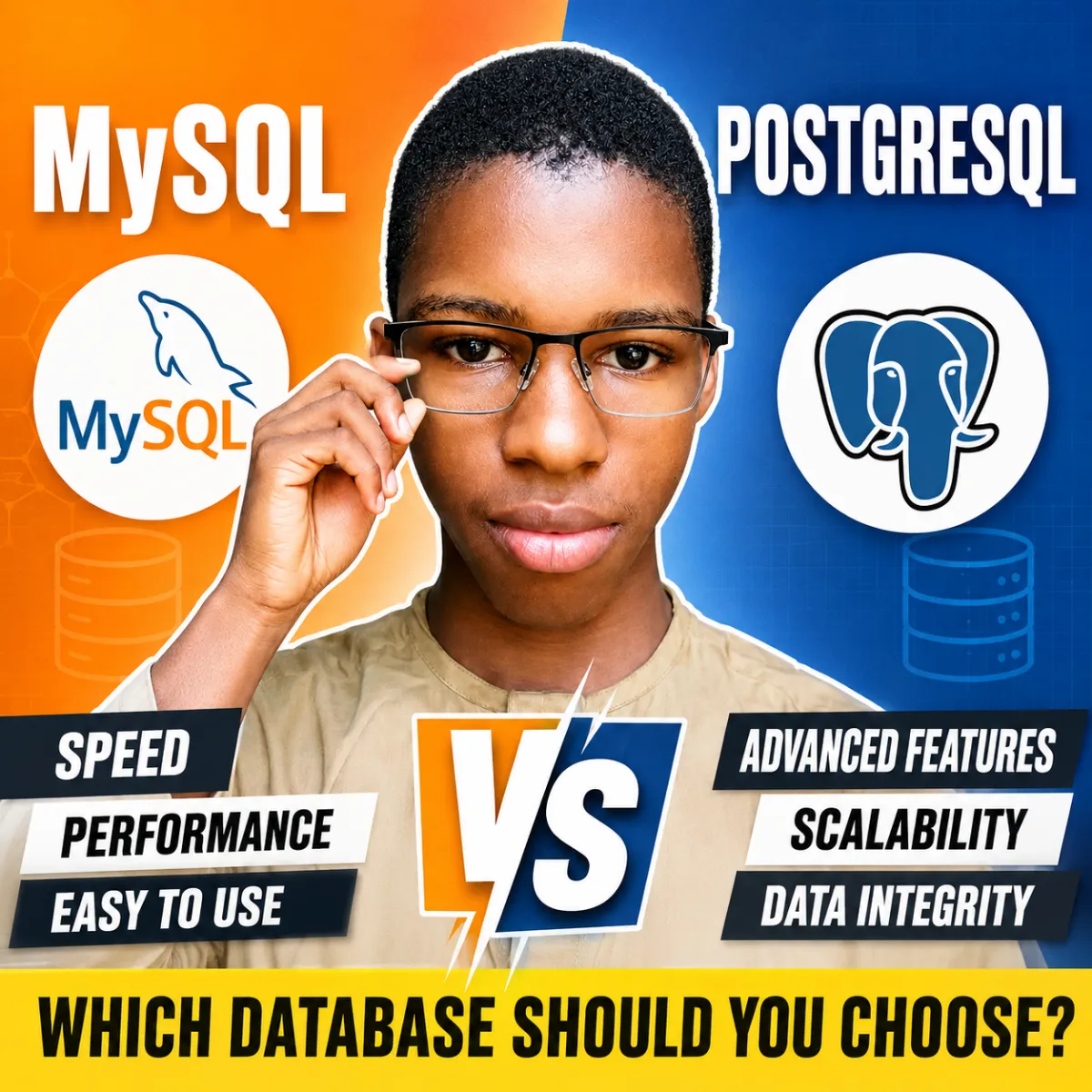
Choosing the right database is one of the most important decisions when building a website, mobile app, or enterprise application. Two of the most popular relational database management systems (RDBMS) are MySQL and PostgreSQL. Both are open-source, reliable, and trusted by millions of developers worldwide.
Although they share many similarities, they are designed with different goals in mind. MySQL focuses on simplicity, speed, and ease of use, while PostgreSQL emphasizes advanced features, standards compliance, and powerful data management capabilities.
In this guide, we'll compare MySQL and PostgreSQL in detail to help you decide which one best fits your project.
What is MySQL?
MySQL is one of the world's most widely used relational databases. Originally released in 1995, it has become the default choice for countless web applications, including WordPress, Joomla, Drupal, and many PHP-based systems.
Today, MySQL is maintained by Oracle Corporation and is available in both Community (free) and Enterprise editions.
Advantages of MySQL
- Easy to learn and use
- Excellent performance for read-heavy workloads
- Large developer community
- Supported by nearly every web hosting provider
- Works perfectly with PHP applications
- Simple installation and maintenance
- Excellent documentation
Disadvantages of MySQL
- Fewer advanced SQL features
- Less strict SQL standard compliance
- Limited support for complex analytical queries
- Not as flexible for advanced database designs
What is PostgreSQL?
PostgreSQL is an advanced open-source relational database that has been under active development for over 30 years. It is known for reliability, data integrity, extensibility, and standards compliance.
Many large organizations, financial institutions, government agencies, and technology companies rely on PostgreSQL for mission-critical applications.
Advantages of PostgreSQL
- Highly SQL compliant
- Supports advanced data types
- Excellent support for JSON and JSONB
- Powerful indexing methods
- Better handling of complex queries
- Advanced concurrency using MVCC
- Highly extensible
- Strong data integrity
Disadvantages of PostgreSQL
- Steeper learning curve
- Slightly more complex administration
- May require more server resources
- Configuration can be more advanced for beginners
Performance Comparison
Performance depends heavily on your workload.
MySQL generally performs exceptionally well for simple read-heavy web applications such as blogs, eCommerce websites, and CMS platforms.
PostgreSQL shines when applications require complex joins, analytical queries, large datasets, transactions, or advanced indexing.
MySQL is faster for:
- Basic CRUD operations
- Simple SELECT queries
- Content management systems
- Shared hosting environments
PostgreSQL is faster for:
- Complex SQL queries
- Large enterprise applications
- Financial systems
- GIS applications
- Business intelligence
Security Comparison
Both databases provide strong security features.
PostgreSQL offers more advanced security capabilities, including row-level security, stronger permission systems, and extensive authentication options.
MySQL also provides robust security but focuses on simplicity.
Scalability
Both databases scale very well.
MySQL is commonly used for horizontally scaled web applications with replication.
PostgreSQL is better suited for applications requiring massive datasets, advanced replication, partitioning, and high availability.
JSON Support
Modern applications frequently use JSON.
MySQL supports JSON data types and functions.
However, PostgreSQL's JSONB implementation is considered one of the best in the database world. JSONB stores data in binary format, making searches and indexing much faster.
SQL Compliance
PostgreSQL follows SQL standards more closely than MySQL.
This makes PostgreSQL an excellent choice for applications that require portability and advanced SQL features.
Concurrency
PostgreSQL uses Multi-Version Concurrency Control (MVCC), allowing many users to access data simultaneously with minimal locking.
MySQL also supports MVCC through the InnoDB storage engine but PostgreSQL's implementation is generally considered more mature.
Backup and Recovery
Both databases offer reliable backup solutions.
PostgreSQL includes advanced point-in-time recovery (PITR), write-ahead logging (WAL), and sophisticated disaster recovery options.
MySQL provides mysqldump, binary logs, replication, and various backup tools.
Developer Experience
If you're a beginner learning PHP or web development, MySQL is usually easier to understand.
If you're building enterprise software, fintech platforms, SaaS applications, or data-intensive systems, PostgreSQL offers greater flexibility and long-term scalability.
Popular Use Cases
Best Use Cases for MySQL
- WordPress websites
- Blogs
- Small business websites
- E-commerce stores
- PHP applications
- Shared hosting projects
Best Use Cases for PostgreSQL
- Enterprise software
- Banking systems
- Healthcare platforms
- Analytics systems
- GIS applications
- Large SaaS platforms
- Machine learning data storage
Feature Comparison Table
| Feature | MySQL | PostgreSQL |
|---|---|---|
| Ease of Learning | ★★★★★ | ★★★★☆ |
| Advanced SQL | ★★★☆☆ | ★★★★★ |
| Performance | ★★★★★ | ★★★★★ |
| JSON Support | ★★★★☆ | ★★★★★ |
| Security | ★★★★☆ | ★★★★★ |
| Scalability | ★★★★☆ | ★★★★★ |
| Community Support | ★★★★★ | ★★★★★ |
| Enterprise Features | ★★★★☆ | ★★★★★ |
Which Database Should You Choose?
Choose MySQL if:
- You are a beginner.
- You use PHP or WordPress.
- You need fast development.
- Your application mainly performs simple database operations.
Choose PostgreSQL if:
- You need advanced SQL capabilities.
- Your project handles complex business logic.
- You require strong data integrity.
- You plan to scale significantly.
- Your application processes large datasets.
Final Verdict
There is no universal winner between MySQL and PostgreSQL because each database excels in different scenarios.
MySQL remains the best option for beginners, content management systems, and traditional web applications where simplicity and speed are priorities.
PostgreSQL stands out for enterprise applications, analytics, fintech, SaaS platforms, and projects requiring advanced SQL features, scalability, and long-term reliability.
If you're building a simple website or PHP application, MySQL is an excellent choice. If you're developing a large-scale or data-intensive application that may grow over time, PostgreSQL is often the better investment.