
 Make us preferred on Google
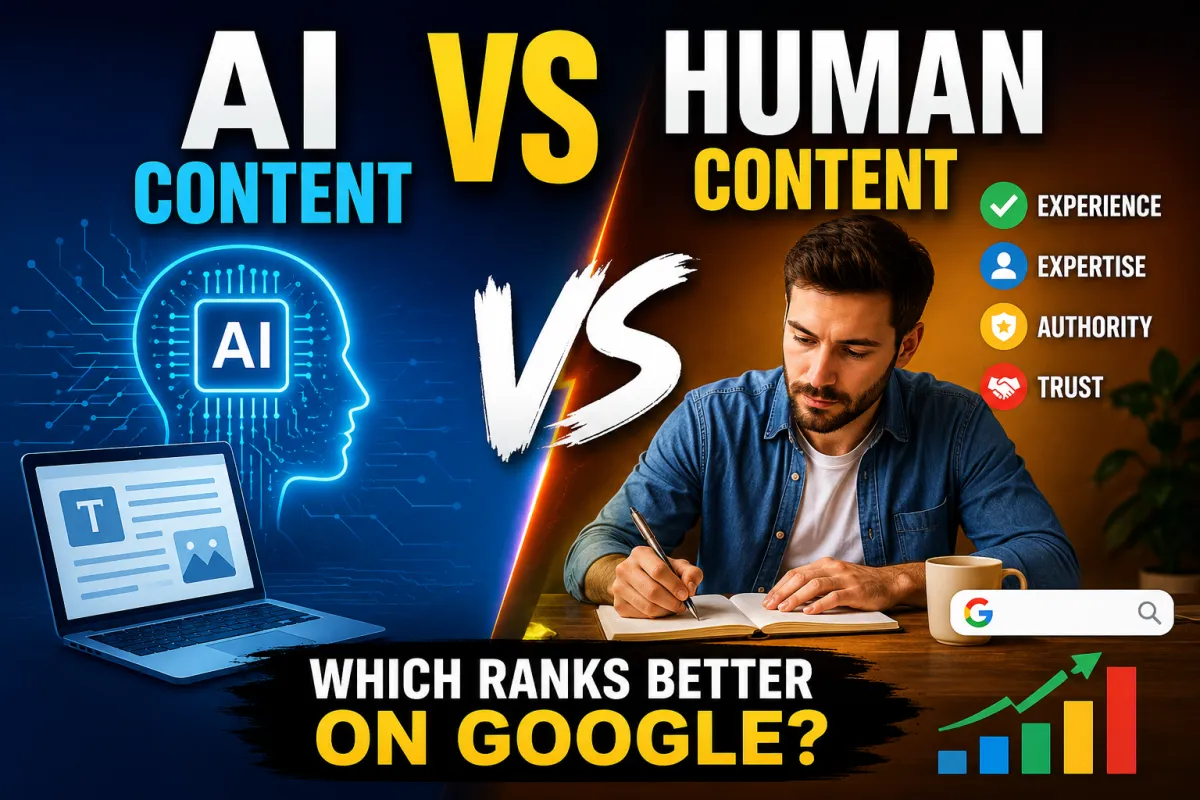
Artificial Intelligence has completely changed the way content is created. Bloggers, marketers, and businesses now use AI tools to generate articles, product descriptions, emails, and even entire websites in just a few minutes. But one important question remains: Does AI content rank as well as human-written content on Google?
The short answer is yes—but only if it provides value to readers. Google does not automatically penalize content simply because it was generated using AI. Instead, Google focuses on the quality, usefulness, originality, and trustworthiness of the content regardless of who—or what—created it.
In this guide, we'll compare AI-generated content with human-written content, explain Google's official position, and show you how to create content that ranks higher in search results.
What Is AI Content?
AI content is text generated using artificial intelligence tools such as ChatGPT, Gemini, Claude, and other language models. These tools analyze billions of words from training data to produce human-like writing based on prompts.
AI can generate:
- Blog posts
- Product reviews
- Website copy
- Emails
- Social media captions
- SEO articles
- News summaries
The biggest advantage of AI is speed. A task that normally takes hours can often be completed within minutes.
What Is Human-Written Content?
Human-written content is created by real writers using personal experience, research, creativity, emotions, and expertise. Humans can understand context better, tell engaging stories, and connect emotionally with readers.
Human writers can also verify facts, perform interviews, conduct original research, and provide unique insights that AI may not have.
Google's Official Position on AI Content
Google has clearly stated that it rewards helpful content regardless of whether it is written by humans or AI. The search engine cares about content quality—not the production method.
Google's Helpful Content System evaluates whether content demonstrates:
- Experience
- Expertise
- Authoritativeness
- Trustworthiness (E-E-A-T)
If AI-generated content is useful, original, accurate, and satisfies user intent, it can rank very well.
Advantages of AI Content
1. Faster Content Creation
AI dramatically reduces writing time, making it possible to publish more content consistently.
2. Lower Costs
Businesses can reduce writing expenses by using AI for drafts and routine content.
3. SEO Assistance
AI can suggest keywords, headings, meta descriptions, FAQs, and internal linking ideas.
4. Scalability
Large websites can produce hundreds of pages much faster than traditional writing methods.
Disadvantages of AI Content
- May contain factual mistakes.
- Can sound repetitive.
- Sometimes lacks personality.
- Limited personal experience.
- May produce outdated information.
- Needs careful editing.
Advantages of Human Content
- Original opinions.
- Personal experiences.
- Creative storytelling.
- Better emotional connection.
- Higher credibility.
- Better understanding of audience needs.
Disadvantages of Human Content
- More expensive.
- Takes longer to produce.
- Limited production speed.
- May require multiple revisions.
Which One Ranks Better?
The truth is that neither AI nor humans automatically rank better.
Google ranks content based on quality, relevance, user satisfaction, authority, and usefulness.
A poorly written human article can perform worse than a well-edited AI article. Likewise, low-quality AI-generated spam will struggle to rank against expert-written content.
The Importance of E-E-A-T
Google's E-E-A-T framework has become increasingly important for SEO.
- Experience – First-hand knowledge.
- Expertise – Subject knowledge.
- Authoritativeness – Reputation.
- Trustworthiness – Accuracy and transparency.
Adding personal experiences, original screenshots, case studies, research, and real examples can significantly improve your content.
Common AI Content Mistakes
- Publishing without editing.
- Keyword stuffing.
- Copying AI output directly.
- Using outdated information.
- No fact-checking.
- No originality.
Best Practices for AI SEO
- Always edit AI drafts.
- Add personal insights.
- Include real examples.
- Fact-check statistics.
- Optimize headings.
- Improve readability.
- Add FAQs.
- Use internal links.
- Optimize images.
- Write compelling meta descriptions.
Should Bloggers Use AI?
Absolutely—but responsibly.
Think of AI as an assistant rather than a replacement. Use AI for brainstorming, outlining, grammar improvements, and first drafts while allowing humans to add expertise, personality, and fact-checking.
The Hybrid Approach
The highest-performing websites often combine AI efficiency with human expertise.
Example workflow:
- Research keywords.
- Generate an outline with AI.
- Create the first draft.
- Add personal knowledge.
- Verify every fact.
- Optimize for SEO.
- Proofread carefully.
- Publish and update regularly.
Will Google Detect AI Content?
Google has explained that detection itself is not the goal. Instead, Google's systems evaluate whether content is helpful and satisfies users.
If AI is used simply to generate low-quality, spammy pages for manipulating rankings, those pages are unlikely to perform well.
Future of AI and SEO
AI writing tools will continue improving, but human expertise will remain valuable. Search engines increasingly reward original experiences, trustworthy information, and genuinely helpful content. Successful creators will use AI to improve productivity while maintaining editorial standards and adding unique value that readers cannot find elsewhere.
Final Thoughts
So, which ranks better on Google—AI or human content? The answer is simple: the better content wins. Google rewards pages that satisfy search intent, demonstrate expertise, and provide real value to users.
Use AI as a productivity tool, not as a shortcut. Combine AI-generated drafts with human editing, original insights, and careful fact-checking to create content that both readers and search engines appreciate. By focusing on quality over quantity, you can build long-term search visibility and sustainable organic traffic.