 Make us preferred on Google
Electricity powers nearly every aspect of modern life, from smartphones and laptops to household appliances and industrial machines. However, not all electricity is the same. The two main types of electrical current are Direct Current (DC) and Alternating Current (AC). Understanding the differences between them can help you make informed decisions when working with electronics, solar systems, batteries, and electrical installations.
What is Direct Current (DC)?
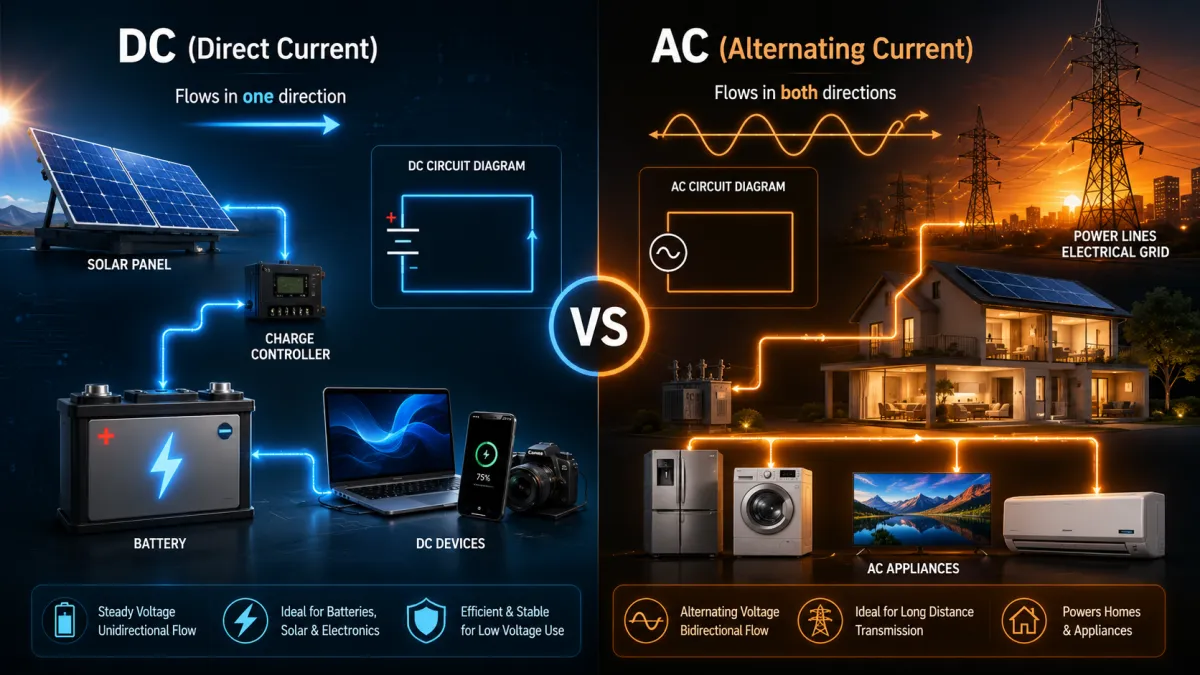
Direct Current (DC) is a type of electrical current that flows in only one direction. In a DC circuit, electrons move steadily from the negative terminal to the positive terminal.
Common sources of DC electricity include:
- Batteries
- Solar panels
- Power banks
- DC generators
- Electric vehicles
Most modern electronic devices such as smartphones, laptops, LED lights, and routers operate internally on DC power.
Advantages of DC Electricity
- More efficient for battery-powered devices.
- Ideal for solar energy systems.
- Provides stable voltage.
- Suitable for low-voltage applications.
Disadvantages of DC Electricity
- Difficult to transmit over long distances.
- Requires converters for voltage changes.
- Can be more expensive for large-scale power distribution.
What is Alternating Current (AC)?
Alternating Current (AC) is a type of electrical current that periodically changes direction. Instead of flowing continuously in one direction, AC switches direction many times per second.
In most countries, AC electricity supplied to homes and businesses operates at either 50 Hz or 60 Hz, depending on the region.
Common sources of AC electricity include:
- National power grids
- Electrical generators
- Wall outlets
- Power stations
Advantages of AC Electricity
- Easy to transmit over long distances.
- Voltage can be increased or decreased using transformers.
- More economical for large power distribution networks.
- Widely available through public utility systems.
Disadvantages of AC Electricity
- Less suitable for battery storage.
- Many electronic devices require conversion to DC.
- Can experience power losses due to frequency-related effects.
Key Differences Between DC and AC
| Feature | DC (Direct Current) | AC (Alternating Current) |
|---|---|---|
| Direction of Flow | One direction only | Changes direction periodically |
| Source | Batteries, Solar Panels | Power Grid, Generators |
| Transmission | Less efficient over long distances | Highly efficient over long distances |
| Voltage Conversion | More complex | Easy with transformers |
| Applications | Electronics, Solar Systems | Homes, Industries, Businesses |
| Frequency | 0 Hz | 50 Hz or 60 Hz |
DC and AC in Solar Power Systems
Solar panels generate DC electricity directly from sunlight. Since most household appliances operate on AC power, an inverter is used to convert DC electricity into AC electricity.
For example:
- Solar Panel → DC Power
- Battery Storage → DC Power
- Inverter → Converts DC to AC
- Home Appliances → Use AC Power
This conversion process is one of the most important parts of any solar energy system.
Which is Better: DC or AC?
Neither DC nor AC is universally better than the other. Each has its own strengths and ideal applications.
- Choose DC for batteries, solar systems, electric vehicles, and portable electronics.
- Choose AC for powering homes, offices, factories, and long-distance electricity transmission.
In fact, modern electrical systems often use both AC and DC together. Solar installations, data centers, and renewable energy systems commonly rely on a combination of both technologies.
Conclusion
DC and AC electricity are the foundation of modern electrical systems. DC provides a steady flow of power and is commonly used in batteries and electronics, while AC is ideal for transmitting electricity across long distances and powering homes and businesses. Understanding the differences between DC and AC can help you better understand how electrical devices, solar systems, and power grids operate.
Whether you're an electrician, solar installer, student, or technology enthusiast, knowing how DC and AC work is an essential part of understanding today's energy systems.